
The Great Wildebeest Migration Explained
The Great Wildebeest Migration: What It Is, How It Works, and What to Expect
Everything you need to know about the Great Wildebeest Migration — what drives it, where it goes, when to see the river crossings and calving season, and how climate change is affecting it.
What exactly is the Great Migration?
Here is the short version: over 1.5 million wildebeest, along with hundreds of thousands of zebra and gazelle, move in a continuous clockwise loop through the Serengeti-Mara ecosystem, following seasonal rainfall and fresh grass. They have been doing this for over a million years. It is the largest overland migration of animals on earth, and it never stops.
The long version is more interesting.
The migration has no start and no finish. Because it is a fluid, year-round movement, there are no defined start or end points. What most people picture when they hear "the migration" (enormous herds thundering into a crocodile-filled river) is one chapter of a much longer story. Knowing the whole story is what separates a well-timed trip from a lucky one.
It is also worth saying upfront: the migration is one of nature's greatest paradoxes. Timing is absolutely vital, but there is no way to predict the timing of the animals' movements. The wildebeest will cross the Mara River — but nobody knows exactly when. Rain will trigger them to move onto fresh grazing — but nobody knows exactly when the rain will fall. The information in this guide is drawn from decades of observation and represents the most reliable patterns available. But every season is unique, and the accelerating pace of climate change is making historically predictable patterns less so. We will come back to that.
The route: a clockwise year in the life of 1.5 million wildebeest
January, February and March — Southern Serengeti: calving season
In late November and December, the herds arrive on the short-grass plains of the southern Serengeti, around Ndutu and into the northern Ngorongoro Conservation Area, dispersed across the plains feeding on fresh, nutritious grasses. They stay here through January, February and March.
This is calving season, and it is extraordinary. Over 500,000 wildebeest calves are born during this period, with around 8,000 calves born per day at peak. The strategy is ancient and deliberate: by flooding the plains with newborns simultaneously, the odds of any individual calf surviving improve dramatically. Predators eat their fill and the rest survive. The result is exceptional predator activity alongside scenes of new life that are, frankly, difficult to prepare yourself for.
February is the peak. Mid-January and March offer almost the same experience with considerably fewer visitors.
April and May — Central Serengeti: the northward march begins
Around April the herds start moving north. By May, the wildebeest all seem to be moving together in a series of columns, often containing hundreds of thousands of animals joined by many zebra, moving through the area around Moru Kopjes and west of Seronera.
Rain plays a huge role in the wildebeest movements at this stage, as heavy rainfall promises lush vegetation and influences the pace and direction of the herds. The rutting season is also in full swing during April and May — males jousting for dominance as the columns move. It is chaotic, hormonal, and spectacular in a completely different way from the calving season.
June — Western Corridor: the Grumeti crossing
Around June the migration is often halted on the south side of the Grumeti River, which has channels that block or slow the northward movement. The wildebeest congregate here in the Western Corridor, often building up to high density before crossing. The river here is normally a series of pools and channels, and whilst it always represents an annual feast for the Grumeti River's large crocodiles, these crossings are not usually quite as spectacular as the Mara River crossings further north.
That said, "not as spectacular as the Mara crossings" is still very spectacular.
The river crossings: what actually happens
Nothing in nature quite prepares you for the first time you watch a crossing. Here is what you are actually seeing.
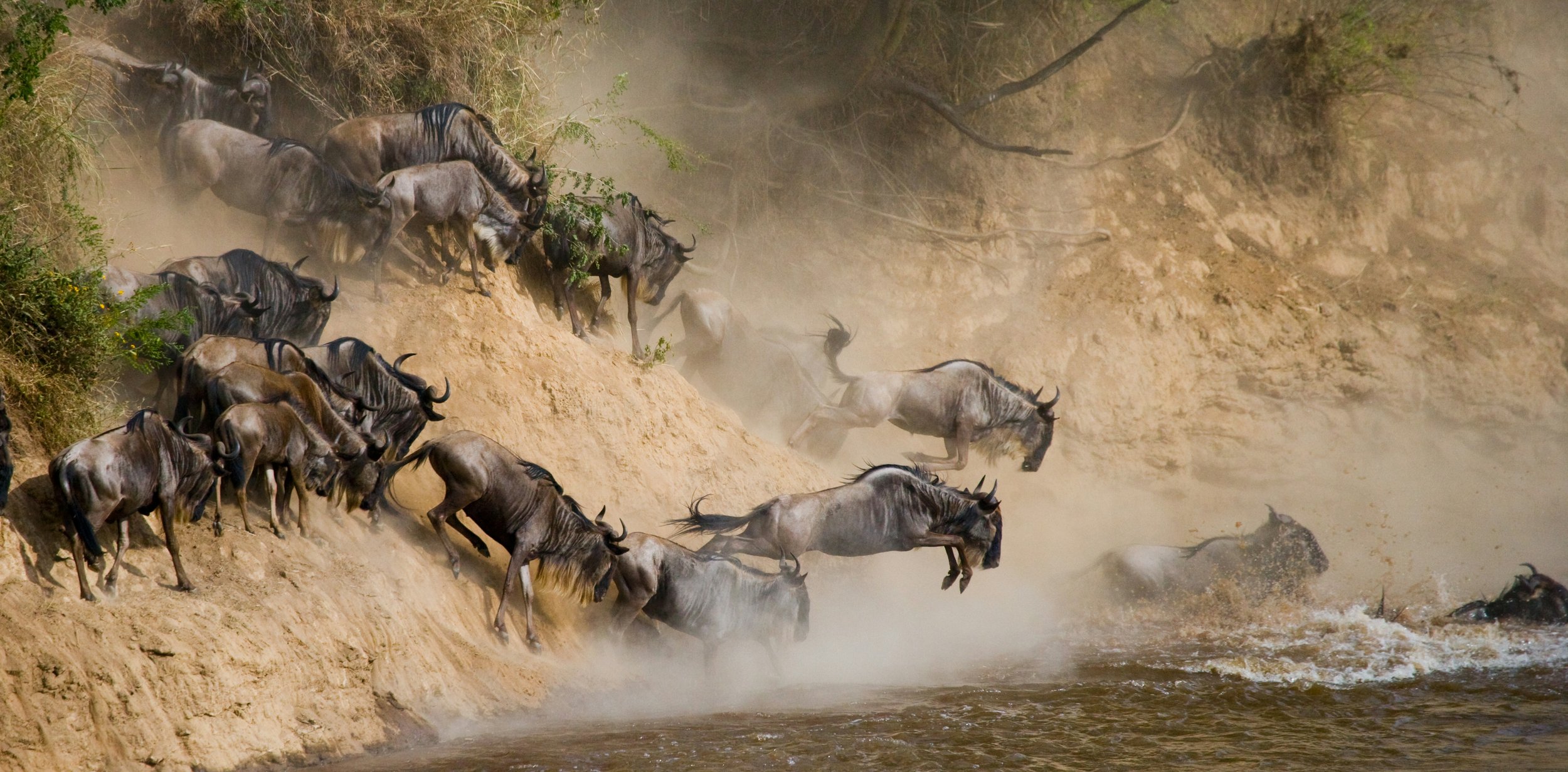
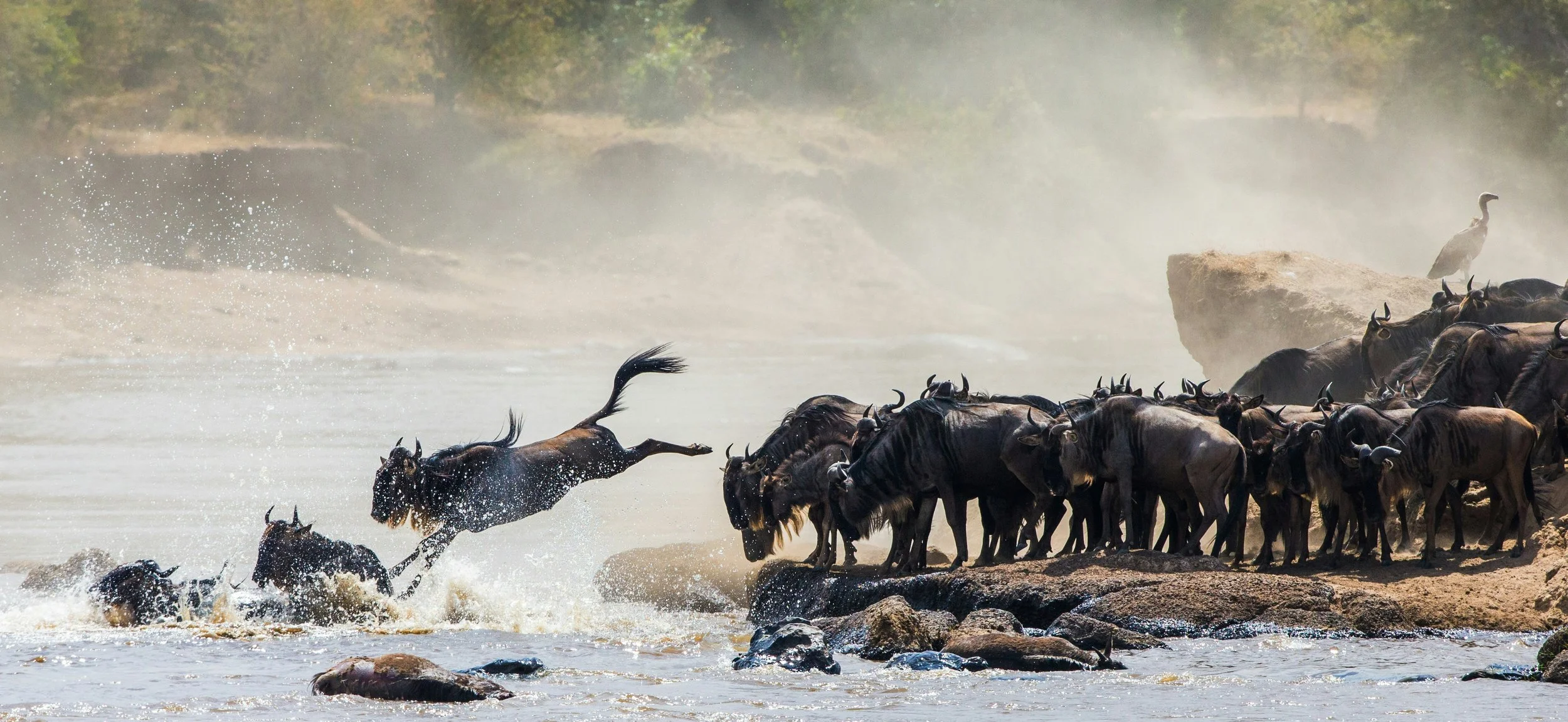
The herds mass on the steep banks of the Mara River — sometimes for hours, sometimes for days — while the animals at the front assess the crossing point, the water level, and the crocodiles. The tension is palpable. Then something shifts. One animal commits, and suddenly thousands follow in a churning, bellowing flood of bodies. The huge herds are driven by their pursuit of fresh pastures, culminating in dramatic river crossings where strong currents and giant Nile crocodiles threaten to cut some of their journeys short.
Climate change and the migration
A 2024 United Nations report found that 44% of the world's migratory species are declining. Key threats to the Great Wildebeest Migration include climate change affecting the availability of water and food sources, habitat loss from expanding agricultural land, fencing blocking migration routes, and poaching — with an estimated 40,000 wildebeest poached for meat each year.
With climate change, the long and short rainy seasons in Tanzania and Kenya are no longer as regular or predictable as they once were. The rains can be late or early, which throws the entire wildebeest calendar out of sync. What this means practically is that the timing patterns in this guide — and in every guide you will read — are based on historical averages that are becoming less reliable season by season. The broad framework holds. The specific windows are increasingly unpredictable.
It also means that tourism revenue, and the conservation funding that flows from it, matters more than ever. Funds from tourism in Tanzania and Kenya support conservation efforts including habitat restoration and anti-poaching measures that help ensure the migration can be witnessed by future generations. Travelling here thoughtfully — through operators who take that responsibility seriously, staying in camps that fund conservation directly — is not a nice-to-have. It is part of what keeps this spectacle alive.
Why do they migrate?
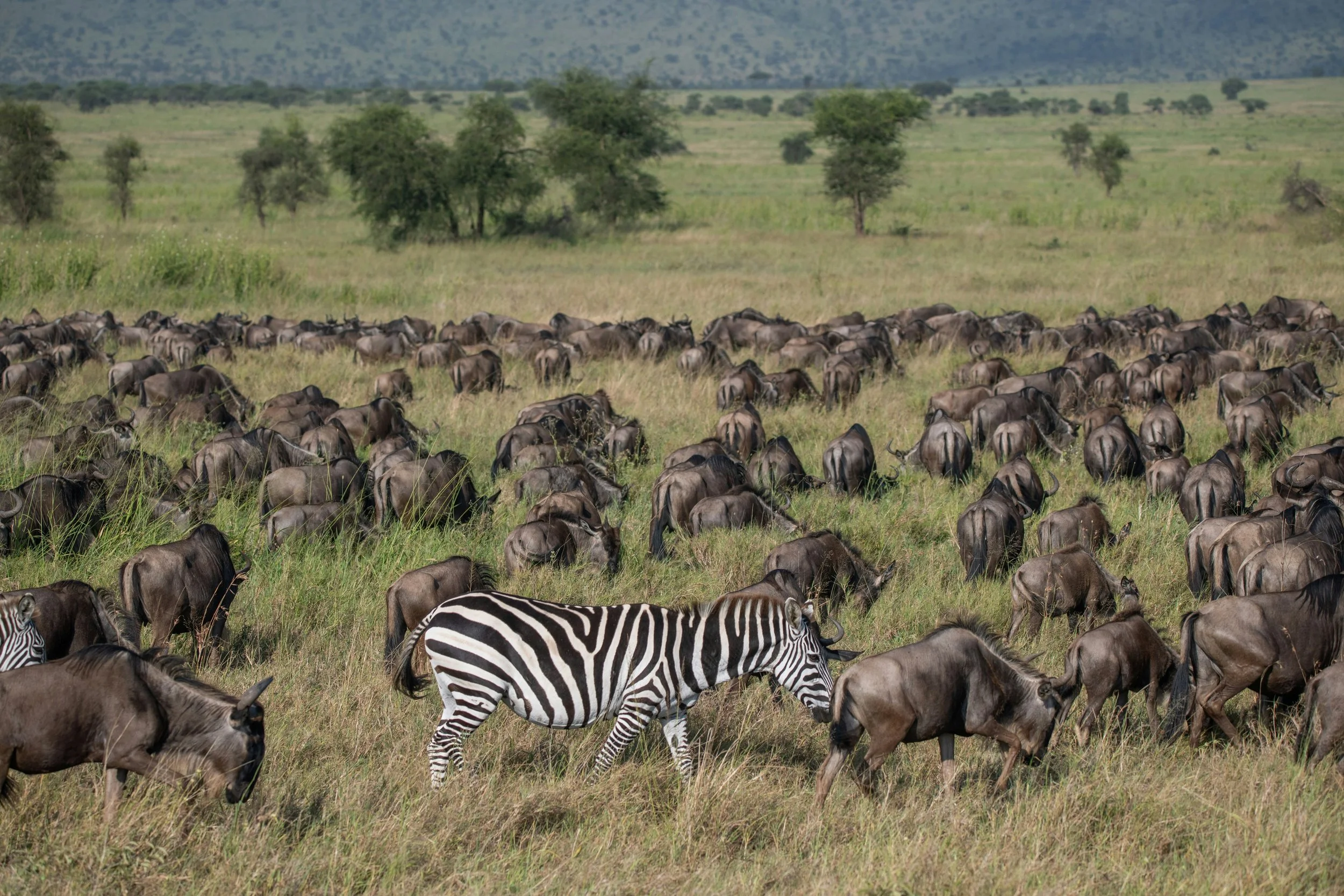
Wildebeest are grazers that need good quality grasses to survive and reproduce. The Serengeti is a huge area and rains fall at different times in different areas, producing nutritious grasses. The animals must follow this rainfall to find enough food to eat, so the large herds are constantly on the move.
The ecosystem has a second layer of logic to it. Zebra and gazelle travel alongside the wildebeest during the migration, but they do not compete for the same food. Zebra eat the top, tough part of the grasses, opening up the shorter grass for wildebeest to eat, which then clear the way to the young grasses that gazelles prefer. Three species, one journey, three different menus. The droppings they leave behind fertilise the soil for the following season. The whole thing is a closed loop of extraordinary ecological intelligence.
The signal for the herds to start moving is the onset of rainfall, which they appear to be able to sense from up to 50 kilometres away. Some researchers believe they respond to distant lightning and thunder. Nobody is entirely sure of the mechanism. What is certain is that it works — it has worked for a million years.
July, August and September — Northern Serengeti and Masai Mara: the river crossings
This is the chapter that made the migration famous. The wildebeest migration continues moving northwards during July and August, often spreading across a broad front — some heading through the Grumeti Reserve, others north through the heart of the Serengeti. September sees the herds spread out across the northern Serengeti, where the Mara River provides the migration with its most serious obstacle.
Watching the frantic herds cross the Mara River can be very spectacular, with scenes of great panic and confusion. It is common to see herds cross north one day and back south a few days later. They follow storms, flee predators, and respond to signals we cannot perceive. A crossing can happen in minutes. The buildup can take days. There is no crossing schedule. That unpredictability is part of what makes witnessing one feel like such an extraordinary piece of luck — even when you have planned carefully for it.
The herds in Kenya's Masai Mara are at their peak numbers from July through October, swelled by local wildebeest populations joining the migration. If you are planning a trip around the crossings, this is your window. Give yourself at least four nights.
October and November — The return south
By October the wildebeest herds are heading south with more accord, moving through western Loliondo and the Serengeti's Lobo area, returning to the green shoots which follow the rains on the short-grass plains of the southern Serengeti in November.
The southbound crossings of the Mara River in late October are often large and dramatic, and they happen with a fraction of the audience that the northbound crossings attract. Worth knowing.
December — And it begins again
By December the herds are back on the southern plains, the females heavily pregnant. The cycle is complete and immediately starts over.
The calving season: the chapter most people overlook
The river crossings are what most people know about. The calving season is what most guides remember.
Between January and March, the southern Serengeti around Ndutu becomes the stage for a phenomenon that has no equivalent anywhere on earth. The wildebeest herds give birth to over 500,000 calves in a synchronised event that attracts predators and visitors alike. Predators including lions, cheetahs and hyenas stalk the vulnerable newborns, adding a thrilling edge to every game drive. The lush green landscape makes for extraordinary photography. The camp sits quietly surrounded by new life and death playing out in every direction.
February is the peak week. But mid-January and March offer almost the same experience with considerably fewer visitors and, typically, better rates.
What about the general wildlife?
The wildebeest do not travel alone, and they are not the only story.
Almost 300 zebra and hundreds of gazelle travel alongside the wildebeest, and predators including lions, cheetahs, leopards, wild dogs, hyenas and crocodiles follow the migration, picking off the old and weak. The Serengeti holds Africa's largest lion population. The Masai Mara consistently produces some of the finest big cat sightings on the continent. An incredible 80% of the world's wildebeest population lives in the Ngorongoro and Serengeti ecosystems — the density of life here is unlike anywhere else on earth, and it extends far beyond the wildebeest themselves.
Your Questions, Answered
-
It is the largest overland migration of animals on earth: over 1.5 million wildebeest, along with hundreds of thousands of zebra and gazelle, moving in a continuous clockwise loop through Tanzania's Serengeti and Kenya's Masai Mara throughout the year, following rainfall and fresh grazing.
-
It depends on what you want to witness. The Mara River crossings are most active from mid-July through October. The calving season in the southern Serengeti peaks in February. Both are extraordinary. The crossings are more dramatic; the calving season is more moving, and significantly less crowded.
-
It never stops. The migration is a continuous, year-round movement. What changes month by month is where the herds are and what they are doing.
-
No. Not even the wildebeest know in advance. Crossings are triggered by a combination of rainfall, predator pressure, herd instinct, and factors we cannot fully measure. The best approach is to be in the right place during the right window, with a good guide, and to give yourself enough time for one to happen.
-
Yes, measurably. Rainfall patterns in East Africa are less predictable than they were twenty years ago, which affects the timing of the migration. Historical calendars are still the best available guide, but every season is unique and the windows of predictability are narrowing. It makes careful planning and flexible itineraries more important than ever.
-
No — you can have a remarkable migration experience in either country alone. But visiting both gives you a more complete picture: Tanzania for calving season and the early northward movement, Kenya for the peak crossing season. Many travellers who visit once come back for the other half of the story.
-
Everything. Lions, leopard, cheetah, elephant, giraffe, buffalo, hippo, crocodile, wild dog, hyena, and an extraordinary diversity of antelope and birdlife are all present year-round. The wildebeest are the headline act. The supporting cast is remarkable in its own right.
-
Profoundly and positively. The herds graze and fertilise the land as they move, supporting the entire food chain from grass to predator. The wildebeest are not just participants in the ecosystem — they are architects of it.